Category Archives: Research

Supplement to the ‘Checklist of the avian diversity of Alaska: subspecies, etc.’

Supplement to the Checklist of the avian diversity of Alaska: subspecies, breeding status, and taxonomy (Withrow et al. 2025), and by extension the 2026 (32nd) Alaska Checklist (https://www.universityofalaskamuseumbirds.org/products/checklist.pdf). (These changes have been incorporated into Withrow et al. 2026, Bull. Amer. Ornithol. Union 1.1.)

The Alaska checklist now stands at 551 species and an additional 120 subspecies. Of these 551 species, 55 are rare, 166 are casual, and 82 are accidental. The following changes are implemented:

Species new to Alaska:

Hawaiian Petrel (Pterodroma sandwichensis), status accidental, based on a bird photographed 12 July 2025 in the Bering Sea, ~130 km nnw of Dutch Harbor (54.921oN 167.511oW) by L. Weiskittel (photos ML).

Broad-winged Hawk (Buteo platypterus), status accidental, based on a bird photographed 15-17 Nov 2025 at Valdez, C. Andersen and J. Guthrie+ (photos ML).

 Subspecies new to Alaska:

Branta canadensis moffitti Aldrich, 1946, status casual, based on several birds matching this description photographed with wild flocks of Canada Geese, predominantly in southeast.

Large, pale Canada Geese associated with wild, migrant flocks have been observed in spring in southeast (e.g., at Juneau, 30 Apr 2007 (G. Van Vliet), 18 May 2008 (P. Suchanek), 2-3 June 2022 (K. Kirkpatrick, G. Van Vliet), and 31 May 2023 (M. Schwan); and Ketchikan, 15-20 Apr 2023 (S. C. Heinl); photos ML for all) where they are unlikely to have been escapes (at least within the state of Alaska). We include here B. c. maxima Delacour, 1951 following Palmer (1976) and Pyle (2008), and further note the long history of introductions and intergradation between maxima and moffitti (Mowbray et al. 2002). An introduced population of moffitti and moffitti/maxima intergrades is thriving on Vancouver Island and the Fraser River delta in sw British Columbia (Dawe and Stewart 2010, Janus et al. 2022), and moffitti phenotypes have become more common in Washington west of the Cascades (Wahl et al. 2005). At least historically, large, pale geese ascribed to B. c. moffitti nested in most of central and southern British Columbia east of the Coast Mountains, but northern limits are unclear (see Munro and Cowan 1947, Campbell et al. 1990).

English name changes:

Common Hoopoe.

The English name Eurasian Hoopoe is changed to Common Hoopoe to conform to global usage (e.g., Dickinson and Remsen 2013, AviList 2025, Chesser et al. 2025).

Linear sequence approach:

We add the following to the Introduction:

Creation of a checklist’s linear sequence from complex phylogenies is as much art as science, governed by a set of conventions that have yet to be agreed upon by major world checklists. To have our list to depart minimally and only in substantive ways from others we will generally follow the linear sequence of the AOS’s North American Classification Committee.

Linear sequence changes:

The linear sequences of Columbidae, Gruiformes, Pelecaniformes, Charadriiformes, and Accipitridae are rearranged following new understandings of relationships (Chesser et al. 2025) and for conformity with the convention of listing more diverse clades or assemblages after less diverse ones.

Columbidae is reordered as follows:

Zenaida asiatica White-winged Dove

Zenaida macroura Mourning Dove

Patagioenas fasciata Band-tailed Pigeon

Streptopelia orientalis Oriental Turtle-Dove

Streptopelia decaocto Eurasian Collared-Dove

Columba livia Rock Pigeon

Gruidae precedes Rallidae in Gruiformes.

Anarhynchus nivosus Snowy Plover precedes Anarhynchus alexandrinus Kentish Plover.

Numenius hudsonicus Hudsonian Whimbrel precedes Numenius phaeopus Eurasian Whimbrel.

Sterninae precedes Larinae in Laridae.

Threskiornithidae comes first within Pelecaniformes.

Accipitridae is partially reordered as follows:

Accipiter striatus Sharp-shinned Hawk

Accipiter nisus Eurasian Sparrowhawk

Astur gentilis Eurasian Goshawk

Astur atricapillus American Goshawk

Circus cyaneus Hen Harrier

Circus hudsonius Northern Harrier

Genus changes:

Bluethroat is removed from a monotypic Cyanecula and returned to Luscinia. Reversion to Luscinia reflects the close relationships within this group (Sangster et al. 2010, Zhao et al. 2023) and avoids multiple monotypic genera within a circumscribed Luscinia.

Lesser Whitethroat is removed from Sylvia and placed in Curruca reflecting a deep divergence within Sylvia senso lato (Voelker and Light 2011, Cia et al. 2019) and to conform to common global usage (e.g., Dickinson and Christidis 2014), although we note that there is wide variation in divergence across avian genera.

New Notes:

Little Ringed Plover.

Genetic work (Dos Remedios et al. 2015, Cerny and Natale 2022) has led some to place C. dubius in an expanded Thinornis, but we retain it in Charadrius given its plumage similarities to members of New World Charadrius, a preference for more inclusive genera, and the recognition that there remains much to learn about the relationships among Charadrius senso lato.

Herring Gull.

Members of the Herring Gull complex (and probably at least some other large white-headed gulls) are better treated as subspecies than species. Genetic diagnosability via clustering algorithms (e.g., Sonsthagen et al. 2016, Linklater et al. 2024), correlated with minor differences in phenotype and long-calls (e.g., Olsen and Larsson 2003), are not indicative of essential reproductive isolation in large white-headed gulls.

Oriental Honey-Buzzard.

The record from Shemya is on the brink of publication as Pohlen et al. (2026; Pohlen, Z. M., J. A. Johnson, R. B. Benter, and J. Helm. 2026. First North American record of the Oriental Honey-Buzzard (Pernis ptilorhynchus). W. Birds 57:in press).

Warbling Vireo.

Treated by some as a species separate from V. g. gilvus (e.g., Phillips 1991, Browning 2019, Chesser et al. 2025). However, genetic work to date (Lovell et al. 2021 and Carpenter et al. 2022) showed rates of intergradation higher than we expect between biological species. Absent convincing evidence of reproductive isolation stronger than that found so far, we consider these to be subspecies of the same biological species.

Status changes:

Status of American White Pelican, Asian Rosy-Finch, Lesser Whitethroat, and Dickcissel are changed from accidental to casual based on a third record for each.

Corrections:

The second subspecies of Ixoreus naevius should be meruloides, not melanuroides; the authority remains correct. The authorship of Cepphuys grylle mandtii is (Lichtenstein, 1822), not (Mandt, 1822). Nazca Booby should have been listed as accidental not casual, it changed status only in the 32nd edition (2026) of the Alaska Checklist.

Literature Cited

AviList Core Team. 2025. AviList: The Global Avian Checklist, v2025. https://doi.org/10.2173/avilist.v2025.

Browning, M. R. 2019. A review of the subspecific and species status of Warbling Vireo (Vireo gilvus). Oregon Birds 45:89-99.

Campbell, R. W., N. K. Dawe, I. McTaggart-Cowan, J. M. Cooper, G. W Kaiser, and M. C. E. McNall. 1990. The Birds of British Columbia, vol. 1. Royal British Columbia Museum, Victoria.

Carpenter, A. M., B. A. Graham, G. M. Spellman, and T. M. Burg. 2022. Do habitat and elevation promote hybridization during secondary contact between three genetically distinct groups of Warbling Vireo (Vireo gilvus)? Heredity 128:352-363.

Cerny, D., and R. Natale. 2022. Comprehensive taxon sampling and vetted fossils help clarify the time tree of shorebirds (Aves, Charadriiformes). Molecular Phylogenetics and Evolution 177:107620.

Chesser, R. T., S. M. Billerman, K. J. Burns, C. Cicero, J. L. Dunn, B. E. Hernandez-Banos, R. A. Jimenez, O. Johnson, N. A. Mason, and P. C. Rasmussen. 2025. Sixty-sixth supplement to the American Ornithological Society’s Check-list of North American Birds. Ornithology 142:1-19.

Cai, T., A. Cibois, P. Alström, R. G. Moyle, J. D. Kennedy, S. Shao, R. Zhang, M. Irestedt, P. G. P. Ericson, M. Gelang, Y. Qu, F. Lei, and J. Fjeldsa. 2019. Near-complete phylogeny and taxonomic revision of the world’s babblers (Aves: Passeriformes). Molecular Phylogenetics and Evolution 130:346-356.

Dawe, N. K., and A. C. Stewart. 2010. The Canada Goose (Branta canadensis) on Vancouver Island, British Columbia. British Columbia Birds 20:24-40.

Dickinson, E. C., and J. V. Remsen, Jr. 2013. The Howard and Moore Complete Checklist of the Birds of the World, 4th edition, vol. 1. Non-Passerines. Aves Press, Eastbourne, United Kingdom.

Dickinson, E. C., and L. Christidis. 2014. The Howard and Moore Complete Checklist of the Birds of the World, 4th edition, vol. 2. Aves Press, Eastbourne, United Kingdom.

Dos Remedios, N., P. L. M. Lee, T. Burke, T. Szekely, and C. Kupper. 2015. North or south? Phylogenetic and biogeographic origins of a globally distributed avian clade. Molecular Phylogenetics and Evolution 89:151-159.

Janus, D., W.S. Boyd, and T.G. Martin. 2022. Introduced Canada Geese in the Fraser River Estuary: a Conservation Challenge. UBC Sustainability Hub, University of British Columbia, Vancouver.

Linklater, E. L. 2021. Population genetic differentiation and hybridization in the Glaucous Gull (Larus hyperboreus). Masters Thesis, Queen’s University, Kingston.

Lovell, S. F., M. R. Lein, and S. M. Rogers. 2021. Cryptic speciation in the Warbling Vireo (Vireo gilvus) Ornithology 138:1-16.

Mowbray, T. B., C. R. Ely, J. S. Sedinger, and R. E. Trost. 2002. Canada Goose (Branta canadensis). In The Birds of North America, No. 682 (A. Poole and F. Gill, eds.). The Birds of North America, Inc., Philadelphia.

Munro, J. A., and I. M. Cowan. 1947. A Review of the Bird Fauna of British Columbia. B. C. Provincial Museum, Victoria.

Olsen, K. M., and H. Larsson. 2003. Gulls of Europe, Asia, and North America. Christopher Helm, London.

Palmer, R. S. 1976. Handbook of North American Birds, vol. 2. Yale University Press, New Haven.

Phillips, A. R. 1991. The Known Birds of North and Middle America, Part II. Denver.

Pyle, P. 2008. Identification Guide to North American Birds, Part II. Slate Creek Press, Point Reyes.

Sangster, G., P. Alstrom, E. Forsmark, and U. Olsson. 2010. Multi-locus phylogenetic analysis of Old World chats and flycatchers reveals extensive paraphyly at family, subfamily, and genus level (Aves: Muscicapidae). Molecular Phylogenetics and Evolution 57:380-392.

Sonsthagen, S. A., R. E. Wilson, R. T. Chesser, J-M. Pons, P-A. Crochet, A. Driskell, and C. Dove 2016. Recurrent hybridization and recent origin obscure phylogenetic relationships within the ‘white-headed’ gull (Larus sp.) complex. Molecular Phylogenetics and Evolution 103:41-54.

Voelker, G., and J. E. Light. 2011. Paleoclimatic events, dispersal and migratory losses along the Afro-European axis as drivers of biogeographic distribution in Sylvia warblers. BMC Evolutionary Biology 11:163.

Wahl, T. R., B. Tweit, and S. G. Mlodinow (eds.). 2005. Birds of Washington: status and distribution. Oregon State University Press, Corvallis.

Withrow, J. J., D. D. Gibson, and K. Winker. 2025. Checklist of the avian diversity of Alaska: subspecies, breeding status, and taxonomy. Bulletin of the American Ornithologists Union, No. 1. https://americanornithologistsunion.org/bulletin/Withrow_et_al_2025_Bull_Amer_Ornithol_Union_Birds_of_Alaska.pdf.

Zhao, M., J. G. Burleigh, U. Olsson, P. Alstrom, and R. T. Kimball. 2023. A near-complete and time-calibrated phylogeny of the Old World flycatchers, robins, and chats (Aves, Muscicapidae). Molecular Phylogenetics and Evolution 178:107646.
Comments on the 2025 Checklist of Alaska Birds

Comments on 31st Alaska Checklist (see also Withrow et al. 2025)

Changes from the 30th Alaska Checklist (for a copy with status symbols, see the pdf version of this post):

►In Family Anatidae delete Anser serrirostris Tundra Bean-Goose and delete the English name Taiga Bean-Goose. Instead maintain Anser fabalis Bean Goose as a single, polytypic species [in which include subspecies A. f. serrirostris].

 ►In Family Columbidae add one species: Columba livia Rock Pigeon [introduced within Alaska].

►Re-order Family Charadriidae and reclassify and/or re-name four species:

Pluvialis squatarola Black-bellied Plover

Pluvialis apricaria European Golden-Plover

Pluvialis dominica American Golden-Plover

Pluvialis fulva Pacific Golden-Plover

Eudromias morinellus Eurasian Dotterel

Charadrius vociferus Killdeer

Charadrius hiaticula Common Ringed Plover

Charadrius semipalmatus Semipalmated Plover

Charadrius dubius Little Ringed Plover

Vanellus vanellus Northern Lapwing

Anarhynchus mongolus Siberian Sand-Plover

Anarhynchus alexandrinus Kentish Plover

Anarhynchus nivosus Snowy Plover

►In Family Scolopacidae delete one subspecies of Numenius phaeopus and add one species: Numenius hudsonicus Hudsonian Whimbrel. Re-name Numenius phaeopus Eurasian Whimbrel [with subspecies N. p. variegatus known in Alaska].

►In Family Scolopacidae emend the spelling of the specific epithet of Calidris pygmaea. 

►In Family Procellariidae add one species: Pterodroma ultima Murphy’s Petrel.

►In Family Sulidae add one species: Sula brewsteri Brewster’s Booby [not Cocos Booby].

►Re-order Family Ardeidae and reclassify or re-name three species:

Botaurus lentiginosus American Bittern

Botaurus sinensis Yellow Bittern

Egretta tricolor Tricolored Heron

Egretta eulophotes Chinese Egret

Egretta garzetta Little Egret

Nycticorax nycticorax Black-crowned Night Heron [no hyphen]

Butorides virescens Green Heron

Ardeola bacchus Chinese Pond-Heron

Ardea alba Great Egret

Ardea intermedia Intermediate Egret [still a single species]

Ardea ibis Cattle Egret [still a single species]

Ardea cinerea Gray Heron

Ardea herodias Great Blue Heron

►In Family Accipitridae add one species: Pernis ptilorhynchus Oriental Honey-Buzzard. 

►In Family Accipitridae, remove goshawks to their own genus: Astur gentilis Eurasian Goshawk and Astur atricapillus American Goshawk.

►In Family Accipitridae add one species: Accipiter nisus Eurasian Sparrowhawk. 

►In Family Accipitridae add one species: Ictinia mississippiensis Mississippi Kite.

►In Family Turdidae delete one species: Turdus eunomus [and add one subspecies to Turdus naumanni Dusky Thrush: T. n. eunomus].

►In Family Motacillidae delete one subspecies of Anthus rubescens and add one species: Anthus japonicus Siberian Pipit.

►In Family Fringillidae delete one species: Acanthis hornemannni Hoary Redpoll [and maintain three subspecies of Acanthis flammea RedpollA. f. flammea, A. f. hornemanni, and A. f. exilipes].

►In Family Calcariidae delete one species: Plectrophenax hyperboreus McKay’s Bunting [and maintain three subspecies of Plectrophenax nivalis Snow Bunting—P. n. nivalis, P. n. hyperboreus, and P. n. townsendi].


Withrow, J., D. D. Gibson, and K. Winker. 2025. Checklist of the avian diversity of Alaska: Subspecies, breeding status, and taxonomy. Bulletin of the American Ornithologists Union 1:1-61.


Danish bird collection comes to UAF

We are delighted to announce the arrival of an invaluable gift—the Erritzoe collection from the House of Bird Research in Denmark. Dr. Johannes Erritzoe has been a Research Affiliate of the University of Alaska Museum (Ornithology) for over 20 years, and his bird collection is an amazing scientific resource. Developed over decades of careful work, this research collection has already been important for scientific productivity. Its importance and use will grow considerably now that it is in Fairbanks, because it has not historically been online or in a public lending institution. The scientific gains for the Museum, for UAF, for this collection, and for ornithology are considerable.

The Erritzoe collection comprises over 8,800 meticulously prepared bird specimens and is highly complementary to the current UA Museum bird collection. A large proportion of Alaska birds are Holarctic in distribution. Many more are the easternmost representatives of Eurasian populations and their close relatives. As such, the Erritzoe collection, most of which is from the northwestern Palearctic, is an important scientific addition to our current holdings. In short, we cannot understand the similarities and uniquenesses of Alaska birds without using complementary material like this—much of which we’ve had to borrow in the past to work in the appropriate comparative framework. This collection is also a fantastic research resource for the study of northern birds and the ways in which climate change affects them.

The permitting and moving of such a large collection was especially challenging, and we thank the many people both in Denmark and the U.S. who helped us accomplish this task. Our next steps are to get the collection catalogued, integrated, and online so that it is widely available to researchers.

(See longer story below, with images.)

Continue reading

Thoughts on changing the name of the Auk and Condor

(Our discipline’s flagship journals are considering a name change after more than a century of success and global recognition. I am opposed, because the potential gains are illusory. A survey [now closed] on this is available here. This change has now been made; with 2021 the experiment begins.)

Authorship for Museum Collections?

A recent paper in Zootaxa by Rouhan and colleagues (here, though paywalled) advocates that collections make such important contributions to published science that they should be recognized as coauthors. The paper is entitled “The time has come for Natural History Collections to claim co-authorship of research articles.” When I began reading their article, I was opposed to the idea. I give credit to the authors, though, for by the time I was finished, I was at least open to the concept. Importantly, they are not advocating for individual museum staff to be coauthors, but rather that an institution or group name for the collection should be used. That was a key distinction for me: I would not want to see collections’ contributions get confused with those of their associated staff. From another perspective, however, when I write a paper that uses many different collections, I would not want to appear as a scientific minion among a small forest of institutions that I happened to use in pursuing my questions. (Imagine the institution shopping that human authors would use!)

The problem Rouhan et al. (2017) are addressing is that museum collections make huge contributions to published science, but those contributions are often unrecognized and difficult to track. Here at the University of Alaska Museum Bird Collection we’ve attempted to solve this in a different way (here), in which we keep track of publications that used our collection in a Google Scholar profile (we published on this here). We were careful not to use the term “author,” however (e.g.,“as if the collection were an author”), and we do not advocate a change to that status for collections. We believe our method serves the purpose quite well without unduly abusing the already contentious issue of authorship.

That said, I do think that museum staff should be authors more often on projects when they make substantial contributions, and that this would happen more often with careful consideration of widely accepted authorship criteria (e.g., here).

But as I noted, my mind is open to the concept of collections as authors if a consensus were to develop that these other two solutions under the present framework were inadequate. It is very uncommon to see institutions or consortia listed as authors, although it is becoming more common in large-scale genomics research.

Avian influenza update, Alaska

Several years ago, Dan Gibson and I published a paper on Asian birds coming to North America through Alaska entitled “The Asia-to-America Influx of Avian Influenza Wild Bird Hosts Is Large.”  In this paper we reversed the conclusions of a popular model of the global spread of highly pathogenic avian influenza (HPAI). We suggested that wild birds are a greater risk than domestic poultry for bringing HPAI into North America. Since then, our model proved the more accurate, presaging the arrival in North America in fall 2014 of a pure Asian strain of H5N2. Wild birds were implicated, and we inferred passage through Alaska. This strain of HPAI went on to cause the worst poultry disease outbreak in U.S. history, resulting in billions of dollars in economic losses.
Continue reading

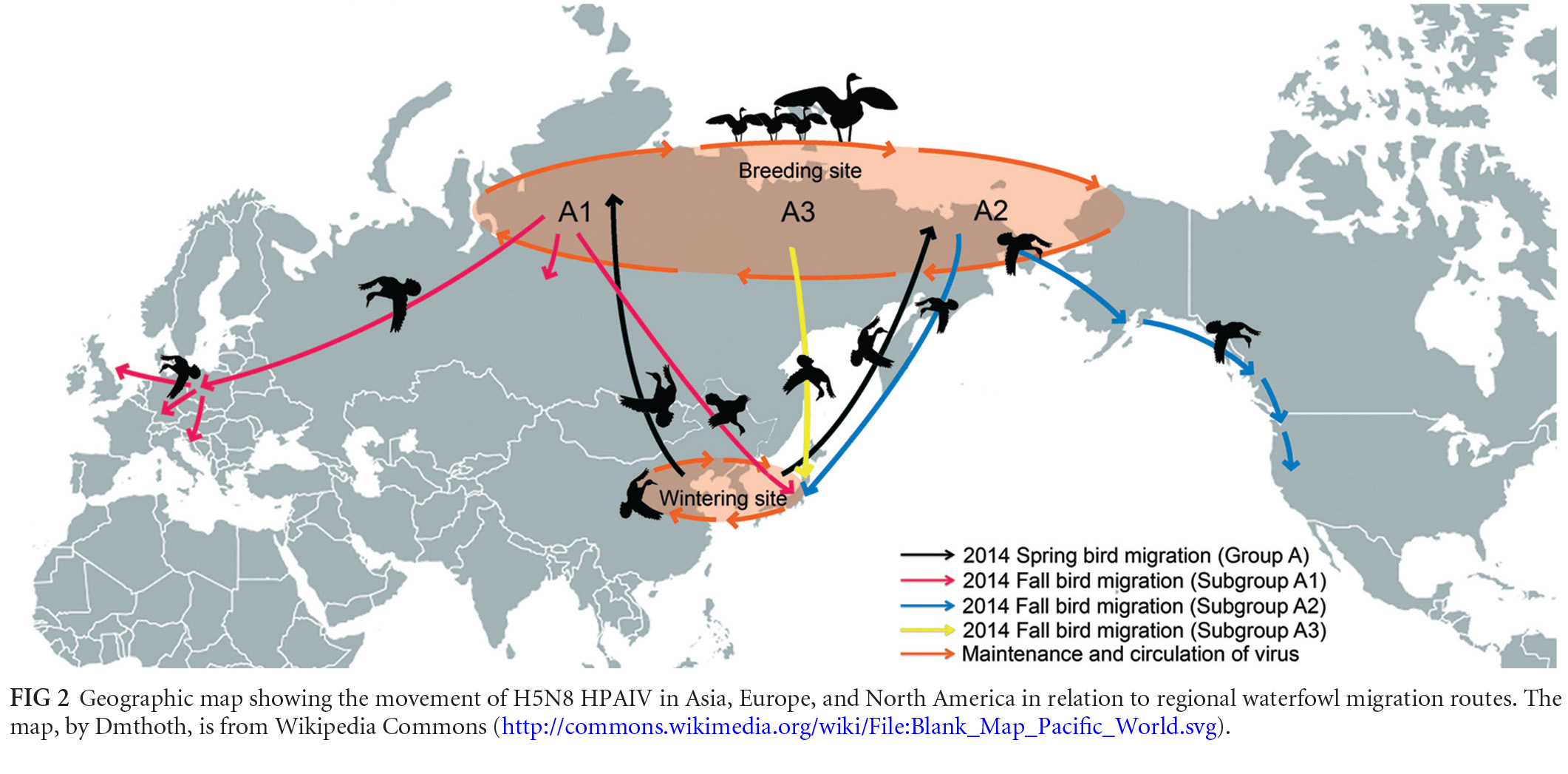
Migratory birds bring avian influenza to North America via Beringia

Our paper is out this month in the Journal of Virology pointing to the importance of Beringia in the intercontinental spread of avian influenza.

A figure from the paper showing the movements of birds and the highly pathogenic avian influenza virus H5N8 in 2014.

A figure from the paper showing the movements of birds and the highly pathogenic avian influenza virus H5N8 in 2014.

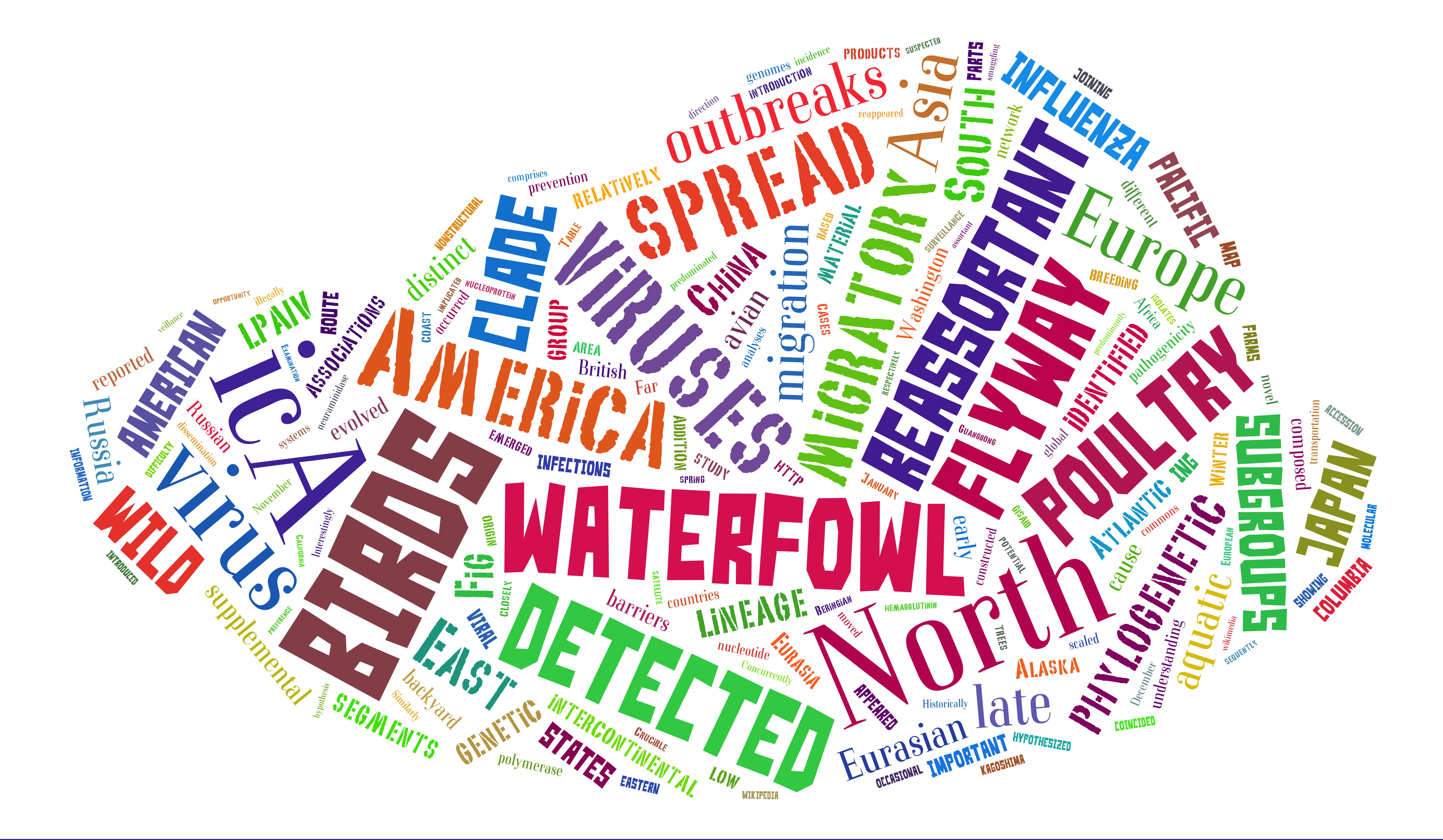
A word cloud of the paper's contents

A word cloud of the paper’s contents


Trends in positions in research collections

In the research museum business, especially in the biological sciences, we’ve long been seeing declines in the number of positions being filled. This is something to be worried about because a) we have a lot to learn about biodiversity still, b) we’re losing said biodiversity at an unprecedented rate, and c) collections need to continue growing because they document so many important aspects of the environments we humans depend on. It’s not like other disciplines in research museums are getting fat at the expense of those disciplines losing positions; it seems to be an industry-wide phenomenon. Vicki Funk of the Smithsonian Institution recently posted an article outlining the dire situation in botany at a global scale.

On the other hand, the rising U.S. economy seems to have opened up a number of new vacancies, leading Michael Ivie of Montana State University to write an email to TAXACOM entitled “What A Great Time to be a Young Systematist”, using his observations of openings in entomology. I agree with Mike from an ornithological perspective: there are a relatively high number of positions opening up this year. Mike’s message has generated a long discussion, however, probably because we recognize that the numbers, while relatively high, are still very small in relation to the magnitude of the issues. In short, a long-declining trend is showing a brief halt and upward bump — and we all hope that collectively at least we see the decline stop and that perhaps we even regain some of those historic losses. There certainly is plenty of work to do, both in traditional biodiversity pursuits and in the new ways that collections are being used to study changes in diseases, contaminants, populations, and environmental and climatic changes.


Super Pato shows advantages of whole-organism sampling

Increasing the scientific bang for every research dollar spent is important, especially in museums, where funding levels are perennially low. When we do get into the field and get our hands on a bird, it costs about the same to bring it home with us as it would to return with just a few drops of blood or a couple of feathers. While there is little difference in the initial cost, there is a huge difference in the scientific potential of the effort’s product: many more scientists can do a lot more things with a whole bird preserved as a specimen than with only a tiny sample likely to be quickly depleted. And the vast majority of bird populations can easily withstand the relatively small amounts of scientific collecting that are done these days.

Continue reading

(Re)affirming the specimen gold standard

A recent opinion paper in Science by a group of authors more concerned with human ethics than with science and biodiversity used a rather broad brush to paint scientific collecting in a negative light. Perhaps through their lack of intimate familiarity with biodiversity science, they made a number of errors in their effort to urge field biologists to stop collecting voucher specimens. Setting aside the issue of why a prestigious journal like Science would publish what is a rather weak contribution, the appearance of this piece does provide an opportunity to again help people understand why scientific collecting is important, why it does not pose a threat to populations of wild organisms, and why in a time of global change adding specimens to collections is now more important than ever. There is a substantial body of peer-reviewed literature on this topic; I will just summarize some of the main points here.

Continue reading